
Individual solutions on a proven machine platform
HERMA precisely adapts the 211R HC robotic labeling cell to individual pharma requirements
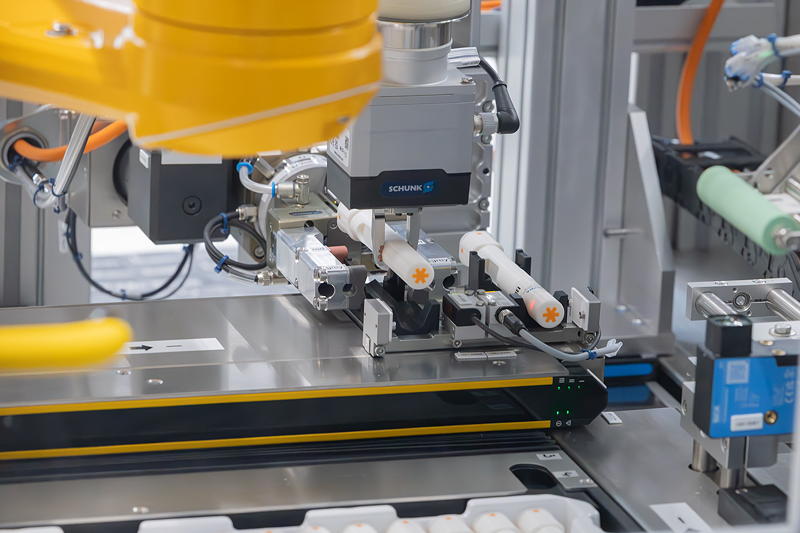
With a configuration adapted for a pharma customer project, HERMA’s 211R HC robotic labeling cell demonstrates how complex labeling processes for autoinjectors can be flexibly automated. The foundation is the proven, standardized 211R HC labeling cell, which HERMA has specifically tailored to the application's exact requirements. At its core is a customer-process-optimized process architecture featuring a Stäubli TS2-100 SCARA robot, a buffer station, and a separate transport and rotation unit. The interplay of these components ensures a stable, reproducible workflow while maintaining gentle handling, even for complex product geometries. The SCARA robot uses a Schunk gripper to remove unlabelled products from trays and places them into a buffer station. There, a transport and rotation unit equipped with Schunk gripping technology takes over. It guides the product to the labeler—a HERMA 500—and precisely rotates it in the required direction during the labeling process. Simultaneously, the robot returns a previously labeled product to the tray and immediately picks up the next one. This parallel operation enables the system to achieve a throughput of up to 15 products per minute. The buffer station decouples product handling from the actual labeling process. Defined handover points and reproducible motion sequences thus create the prerequisites for a stable process during live operations.
Seamless camera-based inspection
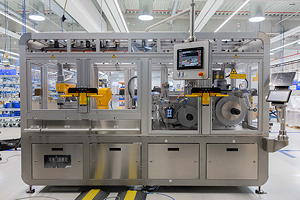
At the same time, the separate transport and rotation unit ensures precise product alignment. This is particularly advantageous for complex geometries and sensitive autoinjectors, which must be handled reliably and gently throughout the entire process. When combined with the customer-specifically integrated transport and rotation unit, the HERMA 500 labeler can fully leverage its precision potential.
An integrated camera system monitors the process and further secures individual process steps. This allows control over labeling accuracy as well as product positioning and orientation, including verification of the applied marking. Non-approved products can be reliably detected and diverted from the downstream process. Maximum process safety is also ensured by HERMA’s proven intuitive drawer system: Products are loaded into the closed labeling cell via the drawer and removed after processing without requiring safety doors to be opened during live operation. This supports a flawless, low-interruption workflow while simultaneously enhancing operator safety.
Standard configuration flexibly adapted to individual requirements
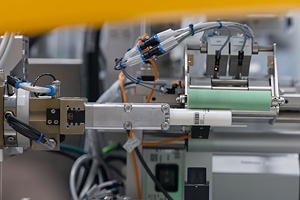
The configuration realized for this customer project underscores the high degree of adaptability of the standardized 211R HC robotic labeling cell. Depending on the product, process, and customer requirements, HERMA integrates suitable automation and robotics components from renowned partners into an optimally coordinated overall concept. Robots, grippers, product handling, labeling technology, and control systems are combined in such a way that they meet specific requirements to the highest standard. The current configuration features a Stäubli TS2-100 along with two Schunk grippers. In other customer projects, components from Fanuc or Weiss Robotics have already been integrated within the same platform. This application clearly demonstrates how HERMA relies on a proven standard concept and adapts it to specific tasks in collaboration with selected partners. “We strategically deploy robotics wherever it makes processes safer, more efficient, and simpler for our customers,” says Jana Paul, Product Management Team Lead at HERMA. “What matters most is the precise interaction of all components—from picking and product handling through labeling to inspection. That’s why we configure our standardized solution specifically for each application and integrate the components that deliver the greatest added value for the customer.”
With its customer-process-optimized architecture, the 211R HC is particularly well-suited for high-mix/low-volume applications. It enables economical labeling not only for autoinjectors but also for items such as syringes or vials, even when dealing with small batch sizes, frequent product changes, or complex geometries. The 211R HC labeling cell combines high precision with flexible automation and can be precisely tailored to a wide variety of requirements.
The HERMA GmbH, headquartered in Filderstadt, is a leading European specialist in packaging and product labeling solutions. In the 2025 fiscal year, the group of companies generated revenue of €447.0 million across its three business segments of pressure-sensitive materials, labels, and labeling machines, employing approximately 1,100 people. The export share stood at 65.8%.
kb